
How to Start Abaya Brand in 2026 (Complete Manufacturing Guide)


Choosing to start abaya brand in 2026 is no longer just a dream — it’s a strategic business opportunity fueled by rising global demand for modest fashion.
The global modest fashion market is expanding rapidly across the USA, UK, Europe, and the Middle East. With rising demand for quality, elegant, and private label abayas, new brands now have access to experienced modest clothing manufacturers who offer low MOQ production and export-ready services.
But here’s the reality:
Most new entrepreneurs fail not because the market is weak—
but because they choose the wrong supplier, skip sampling, or misunderstand how abaya manufacturing works.
In this complete guide, you’ll learn:
- How to define your brand positioning
- How to choose between a manufacturer and a wholesaler
- How to plan your MOQ and production budget
- How private label manufacturing builds long-term brand value
- And how to avoid costly sourcing mistakes
If you’re serious about building a scalable abaya brand—not just reselling products—this guide is for you.
Why 2026 Is the Best Time to Start an Abaya Brand
The modest fashion industry is no longer a niche — it’s a fast-growing global market.
In 2026, starting an abaya brand is not just possible — it’s strategically smart.
Global Demand Is Rising — Not Slowing Down
Demand for modern, elegant, and high-quality abayas is growing rapidly across:
- 🇺🇸 USA (Muslim communities + modest fashion trend buyers)
- 🇬🇧 UK (Boutique and online modest brands)
- 🇪🇺 Europe (Ethical + minimalist fashion movement)
- 🇦🇪 Middle East (Premium and luxury abaya segment)
Buyers are no longer looking for generic designs. They want:
- Unique cuts
- Premium fabrics
- Consistent sizing
- Strong branding
This creates a massive opportunity for new brands who work directly with experienced modest clothing manufacturers instead of middlemen.
If you’re exploring bulk sourcing, read our detailed guide on
Modest Clothing Manufacturers vs Wholesalers.
Private Label Manufacturing Is More Accessible Than Ever
In the past, starting a fashion brand required:
- Huge capital
- Large factory orders
- High production risk
Today, many private label manufacturers offer:
- Low MOQ production
- Sampling before bulk orders
- Custom sizing
- Custom packaging
- Export-ready production
This means you can launch professionally without ordering thousands of pieces upfront.
Learn more about how private label works in our
Private Label Modest Clothing Manufacturing Guide.
E-Commerce Has Removed Entry Barriers
You no longer need a physical boutique to launch your brand.
With Shopify, WooCommerce, TikTok Shop, and Instagram:
- You can start with 10–20 designs
- Test your market digitally
- Scale production based on demand
The key is working with a manufacturer who can:
- Maintain consistent quality
- Handle repeat production
- Support international shipping
Before production, review our
Abaya Wholesale Buying Guide (MOQ & Quality Checklist).
Buyers Trust Brands — Not Resellers
Today’s customers care about:
- Brand story
- Fabric quality
- Fit consistency
- Ethical production
Reselling stock designs limits long-term growth.
Building your own brand through a private label abaya manufacturer creates:
- Higher profit margins
- Brand loyalty
- Repeat customers
- Wholesale expansion opportunities
2026 is the year of brand ownership — not product flipping.
If you plan to build something scalable and international, starting now positions you ahead of the next wave of modest fashion growth.
Define Your Abaya Brand Identity Before Production
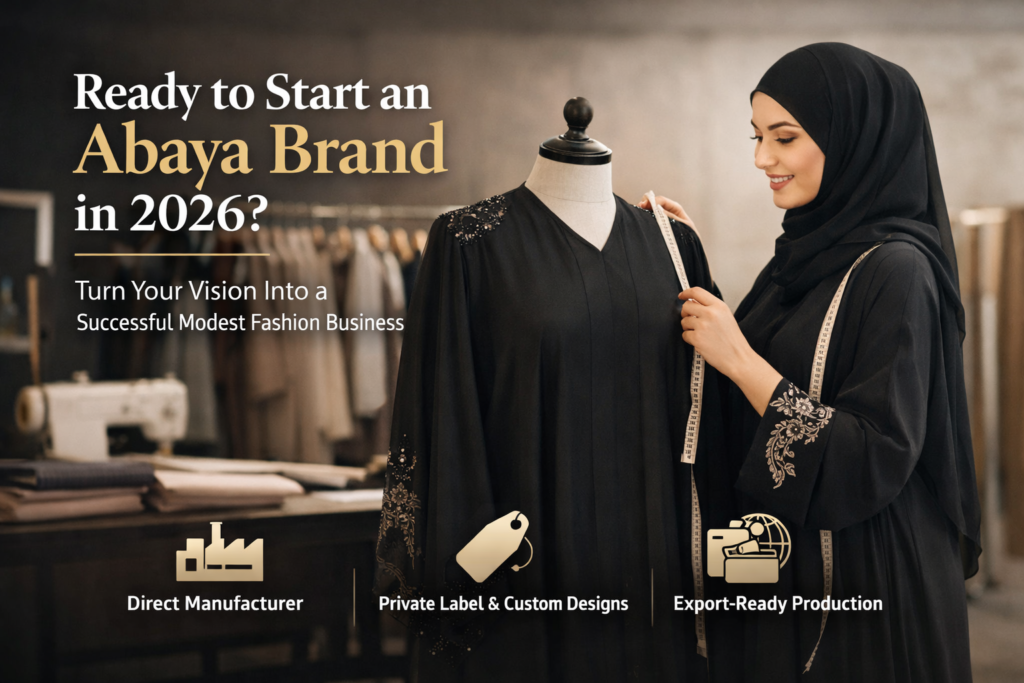
Starting an abaya brand in 2026 without a clear identity is one of the biggest mistakes new entrepreneurs make.
Before you contact a manufacturer, before you request samples, before you talk about MOQ — you must define your brand foundation.
Because manufacturers produce products.
But brands build long-term businesses.
Define Your Target Market Clearly
Ask yourself:
- Are you targeting luxury buyers in the UAE?
- Boutique owners in the UK?
- Online modest shoppers in the USA?
- Budget-conscious resellers in Europe?
Each market requires different:
- Fabric choices
- Embroidery level
- Pricing structure
- Packaging style
For example:
- USA buyers prefer breathable, lightweight fabrics.
- Middle East markets prefer premium nida and embroidery.
- EU markets lean toward minimalist neutral tones.
Before choosing fabric, read our
Best Fabric for Abaya: Complete Material Guide.
Choose Your Brand Positioning
Your abaya brand must stand for something.
Are you:
- Minimal & Modern?
- Luxury & Embroidered?
- Everyday Affordable?
- Boutique Premium?
This positioning affects:
- Fabric selection
- Design complexity
- Production cost
- Your marketing angle
Manufacturers can produce anything — but they need clear direction.
Decide: Private Label or Generic Wholesale?
If your goal is long-term growth, private label is non-negotiable.
Private label allows you to:
- Add your logo
- Customize packaging
- Control sizing
- Maintain design consistency
- Build brand trust
Learn how private label manufacturing works here:
Private Label Modest Clothing Manufacturing Guide.
Plan for Scalability from Day One
Many new brands fail because they start with:
- No production plan
- No repeat order structure
- No fabric continuity
A serious brand in 2026 must:
- Work with a consistent manufacturer
- Keep fabric records
- Maintain design grading standards
- Plan restocking cycles
This is why growing brands prefer working directly with experienced manufacturers rather than switching suppliers every season.
If you’re still unsure whether to choose a wholesaler or manufacturer, read:
Modest Clothing Manufacturers vs Wholesalers.
Authority Insight
The brands that will dominate modest fashion in 2026–2028 are not the ones selling random designs.
They are the ones who:
- Control their production
- Own their brand identity
- Build direct manufacturing partnerships
And it all starts before you place your first bulk order.
How to Choose the Right Abaya Manufacturer in 2026
Choosing the right abaya manufacturer is the most important decision you will make when starting your brand.
In 2026, competition is higher — but so are the opportunities. The difference between a successful abaya brand and a failed one often comes down to one thing:
The quality and reliability of the manufacturer you choose.
Work With a Direct Manufacturer — Not a Middleman
Many buyers make the mistake of sourcing through:
- Trading companies
- Marketplaces
- Resellers claiming to be factories
The problem?
You lose control over:
- Fabric consistency
- Stitching quality
- Pricing transparency
- Lead time reliability
A real abaya manufacturer:
- Produces garments from raw fabric
- Controls cutting, stitching, finishing
- Offers sampling before bulk
- Supports private label production
If you’re unsure about the difference, read:
Modest Clothing Manufacturers vs Wholesalers
Check Fabric Knowledge & Production Capability
A serious abaya manufacturer should be able to guide you on:
- Nida vs crepe vs satin
- Climate-appropriate fabrics
- Embroidery handling
- Bulk stitching consistency
They should not just “accept orders” — they should advise you.
Before selecting fabric, review:
Best Fabric for Abaya – Complete Guide
Ask About Sampling & Size Grading
Never skip sampling.
Professional manufacturers provide:
- Pre-production samples
- Fit testing options
- Size grading charts
- Fabric swatches
This reduces risk before bulk production.
If a supplier refuses sampling — that’s a red flag.
Confirm MOQ & Scalability
In 2026, good manufacturers offer:
- Flexible MOQ for startups
- Scalable production for growth
- Repeat order consistency
Ask these questions:
- What is the minimum order quantity?
- Can you repeat the same fabric after 3 months?
- What is the production timeline?
- Do you support export documentation?
Low MOQ is helpful — but scalability is critical.
Check Export & International Shipping Experience
If you plan to sell in:
- USA
- UK
- Europe
- Middle East
Your manufacturer must understand:
- Export packaging standards
- International labeling requirements
- Shipping timelines
- Documentation process
Working with an export-ready manufacturer reduces delays and customs problems.
Authority Insight
The best abaya brands in 2026 do not chase the cheapest supplier.
They build long-term partnerships with:
- Transparent manufacturers
- Private label specialists
- Quality-controlled production teams
Because consistency builds brand trust — and trust builds repeat customers.
Understanding MOQ, Pricing & Startup Budget for an Abaya Brand
Before you launch your abaya brand, you must clearly understand three critical factors:
- MOQ (Minimum Order Quantity)
- Manufacturing pricing
- Your total startup budget
Many new entrepreneurs underestimate these elements — and that’s where mistakes begin.
Let’s break it down properly.
What Is MOQ in Abaya Manufacturing?
MOQ (Minimum Order Quantity) refers to the minimum number of pieces a manufacturer requires per design, color, or order.
For example:
- 50 pieces per design
- 100 pieces per color
- Mixed size ratio per style
MOQ depends on:
- Fabric sourcing
- Cutting efficiency
- Production cost structure
- Customization level
Private label production may have slightly different MOQ compared to ready wholesale stock.
If you’re exploring full-scale manufacturing, see our
Modest Clothes Wholesale Manufacturing Guide.
What Affects Abaya Manufacturing Pricing?
Pricing is never random. It is calculated based on:
- Fabric type (nida, crepe, satin, cotton blends)
- Design complexity
- Embroidery & handwork
- Stitching details
- Quantity ordered
- Custom labeling & packaging
- Export packing requirements
For example:
A simple everyday abaya in crepe will cost significantly less than a heavily embroidered wedding abaya in premium nida.
For detailed cost breakdown, read:
Abaya Wholesale Price Explained.
Planning Your Startup Budget
When starting your abaya brand, your budget should include:
- Sample development cost
- Fabric & production cost
- Branding (labels, tags, packaging)
- Photography & marketing
- Shipping & customs
- Website or online store setup
Most new brands make the mistake of budgeting only for production — but branding and marketing are equally important.
Low MOQ vs Cost Efficiency
Lower MOQ is helpful for beginners.
But remember:
- Smaller orders = higher per-piece cost
- Larger orders = better cost efficiency
The goal is not just to start small —
but to plan scalability.
An experienced abaya manufacturer will guide you on:
- Smart first-order quantity
- Break-even strategy
- Repeat production planning
Strategic Insight for 2026
In 2026, smart brands do not compete only on price.
They compete on:
- Fabric quality
- Fit consistency
- Brand identity
- Production reliability
Understanding MOQ and pricing helps you build a profitable brand — not just place an order.
Private Label vs White Label – Which Is Better for Your Abaya Brand?
When starting an abaya brand, one of the most important strategic decisions you’ll make is choosing between private label and white label production.
At first glance, both may seem similar — but in reality, they lead to very different long-term outcomes.
Let’s break it down clearly.
What Is White Label Abaya Production?
White label means:
- You purchase ready-made designs
- You add your logo (sometimes)
- Limited or no customization
- Same product may be sold to multiple buyers
This model is often used for:
- Testing a market quickly
- Small local resellers
- Short-term selling strategies
However, white label has limitations:
- No design ownership
- Limited size flexibility
- Harder to build brand uniqueness
- Lower pricing control
It’s faster to start — but harder to scale.
What Is Private Label Abaya Manufacturing?
Private label means:
- Your custom designs (or modified factory designs)
- Your sizing chart
- Your fabric choice
- Your packaging
- Your branding
The product becomes your brand’s identity.
Private label allows you to:
- Build customer trust
- Maintain consistency
- Control quality
- Create long-term brand value
- Scale internationally
Learn more about full private label manufacturing here:
Private Label Modest Clothing Manufacturing Guide.
Which One Is Better for 2026?
If your goal is:
- Building a serious brand
- Selling internationally
- Creating repeat customers
- Increasing long-term profit margins
Then private label is the stronger model.
White label works for short-term selling.
Private label builds long-term business assets.
Why Serious Abaya Brands Choose Private Label
In 2026, customers care about:
- Brand identity
- Fabric consistency
- Fit reliability
- Packaging experience
These cannot be controlled properly through white label.
Private label production gives you:
- Brand authority
- Better positioning
- Higher perceived value
- Stronger wholesale opportunities
Strategic Insight
If you’re planning to grow beyond small local sales and enter:
- USA
- UK
- EU
- Middle East
Private label manufacturing provides the foundation needed for scalability.
The decision you make at this stage determines whether your abaya brand becomes:
A reseller
or
A recognized brand.
Sampling & Quality Control Before Bulk Production
If there is one step that protects your abaya brand from financial loss — it is sampling and quality control.
Skipping this stage is one of the biggest mistakes new brand owners make.
Before placing a bulk order, you must test everything.
Why Sampling Is Non-Negotiable
A production sample allows you to verify:
- Fabric feel and weight
- Stitching quality
- Sleeve length and overall fit
- Color accuracy
- Embroidery finishing
- Button and accessory quality
Even a small measurement error can damage your brand reputation once products reach customers.
Professional modest clothing manufacturers always recommend a pre-production sample before bulk.
Fit & Size Verification
Abaya sizing varies by market.
For example:
- USA buyers may prefer slightly relaxed silhouettes
- UK markets expect consistent grading
- Middle East markets may prefer specific length proportions
During sampling, you must:
- Approve size chart
- Test sleeve length
- Confirm shoulder width
- Verify overall drape
If you need sizing guidance, review:
Abaya Size & Measurement Guide.
Fabric Testing Before Bulk
Fabric must be checked for:
- Shrinkage
- Color bleeding
- Texture consistency
- Comfort in different climates
For example:
Nida fabric behaves differently than crepe or satin.
For deeper understanding, read:
Best Fabric for Abaya – Complete Guide.
Quality Control During Bulk Production
Sampling is only the first step.
During production, experienced manufacturers implement:
- Stitching inspections
- Thread strength checks
- Embroidery alignment checks
- Final finishing inspection
This ensures:
- Consistency across all pieces
- Reduced return risk
- Better brand credibility
What Happens If You Skip Sampling?
You risk:
- Incorrect sizing
- Fabric mismatch
- Poor finishing
- Customer complaints
- Unsellable inventory
For startups, this can destroy early momentum.
Strategic Insight for 2026
Strong brands are built on:
- Consistent fit
- Reliable quality
- Repeatable production standards
Sampling protects your brand before it reaches the market.
Bulk production should only begin after full sample approval.
Production Timeline, Shipping & Export Process Explained
Once your sample is approved, the next critical stage is understanding the production timeline and export process.
In 2026, speed matters — but reliability matters more.
A professional abaya manufacturer will provide clear timelines, structured production stages, and export-ready support.
Let’s break it down.
Production Timeline – What to Expect
Production time depends on:
- Order quantity
- Fabric availability
- Design complexity
- Embroidery or handwork
- Custom labeling requirements
Typical timeline structure:
Fabric sourcing: 3–7 days
Cutting & stitching: 7–20 days
Finishing & QC: 3–5 days
Final packing: 2–4 days
Average total timeline:
15–30 days for most bulk abaya production.
Luxury or heavy embroidery collections may take longer.
Always confirm:
- Lead time before payment
- Production capacity
- Repeat order timeline
Consistency in timeline is a sign of an experienced manufacturer.
Packing for International Buyers
Export-ready packaging includes:
- Individual poly bag packing
- Size tagging
- Brand labeling
- Carton export packing
- Barcode (if required)
International buyers often require:
- Clear labeling
- Fabric composition tag
- Country of origin label
A serious manufacturer understands these requirements.
Shipping & Export Process
If you are selling in:
- USA
- UK
- EU
- Middle East
Your supplier must understand:
- Export documentation
- Commercial invoice
- Packing list
- HS code classification
- Shipping method selection
Shipping options include:
- Air freight (faster, higher cost)
- Sea freight (slower, cost-effective for large orders)
- Courier express (DHL, FedEx for smaller batches)
Export Experience Matters
Many buyers lose money because their supplier:
- Has no export license
- Does not understand customs documentation
- Cannot properly pack bulk garments
This causes:
- Delays
- Extra customs charges
- Damaged goods
Working with export-ready modest clothing manufacturers reduces these risks.
Strategic Insight
Production quality builds your brand reputation.
But delivery reliability builds your business trust.
In international wholesale, both matter equally.
Choose a manufacturing partner who understands:
- Timeline management
- Export standards
- Consistent repeat production
Common Mistakes New Abaya Brands Make (And How to Avoid Them)
Starting an abaya brand in 2026 is a smart move — but many new entrepreneurs lose money not because the market is weak, but because they make avoidable sourcing mistakes.
Here are the most common mistakes — and how to avoid them.
Choosing the Cheapest Supplier
This is the most dangerous mistake.
New buyers often:
- Compare only price per piece
- Ignore fabric quality
- Skip stitching inspection
- Overlook export experience
Low pricing often means:
- Inconsistent fabric
- Weak stitching
- Poor finishing
- Delayed production
How to Avoid It:
Choose a manufacturer based on:
- Quality control process
- Sample approval system
- Production transparency
- Export experience
Remember:
Cheaper production often becomes more expensive in the long run due to returns and brand damage.
Skipping Sampling Before Bulk
Some buyers try to save time and money by skipping samples.
This leads to:
- Wrong sizing
- Incorrect sleeve length
- Fabric mismatch
- Unexpected embroidery finish
How to Avoid It:
Always request:
- Pre-production sample
- Size grading confirmation
- Fabric swatch approval
Sampling protects your investment.
No Clear MOQ Understanding
Many startups place orders without fully understanding:
- Minimum order per design
- Size breakdown requirements
- Repeat order conditions
This causes confusion and pricing misunderstandings.
How to Avoid It:
Discuss:
- MOQ per style
- Mixed size ratio
- Scalability options
- Cost difference between small vs larger runs
Clarity before payment prevents future conflict.
Ignoring Export Experience
International buyers must verify:
- Does the supplier understand export documentation?
- Can they pack properly for overseas shipping?
- Do they know labeling standards?
Without export experience, you risk:
- Delayed shipments
- Customs issues
- Additional fees
How to Avoid It:
Work with export-ready modest clothing manufacturers who regularly ship internationally.
Not Planning for Long-Term Production
Some brands:
- Switch suppliers every season
- Change fabric every order
- Have no size standard
This destroys brand consistency.
Customers expect:
- Same fit
- Same fabric feel
- Same quality
How to Avoid It:
Build a long-term relationship with a reliable manufacturer.
Strategic Positioning Insight
Experienced manufacturers guide buyers through these steps to avoid loss.
They help with:
- Fabric selection
- Sampling
- MOQ planning
- Production scheduling
- Export documentation
A strong manufacturing partner reduces risk and supports brand growth.
Ready to Start Your Abaya Brand With a Manufacturer?
If you’re serious about launching a professional abaya brand in 2026, the most important decision you’ll make is choosing the right manufacturing partner.
Not a reseller.
Not a middleman.
Not a random marketplace supplier.
But a direct abaya manufacturer who understands:
- Private label production
- Fabric quality control
- MOQ flexibility
- Export-ready shipping
- Long-term brand scalability
Building a brand is different from placing an order.
When you work directly with a manufacturer, you gain:
✔ Better cost transparency
✔ Consistent fabric & sizing
✔ Custom branding options
✔ Repeat production reliability
✔ Long-term business support
If your goal is to create a brand that grows internationally — not just sell a few pieces — working with an experienced modest clothing manufacturer is the smartest move.
Take the Next Step
Whether you are:
- A startup planning your first collection
- A boutique owner expanding internationally
- An online seller building a private label brand
- A distributor looking for scalable production
We’re ready to guide you through the process.
👉 Talk to a Manufacturer
👉 Request MOQ & Pricing Details
👉 Start Your Abaya Brand Today
Your brand deserves strong production foundations.
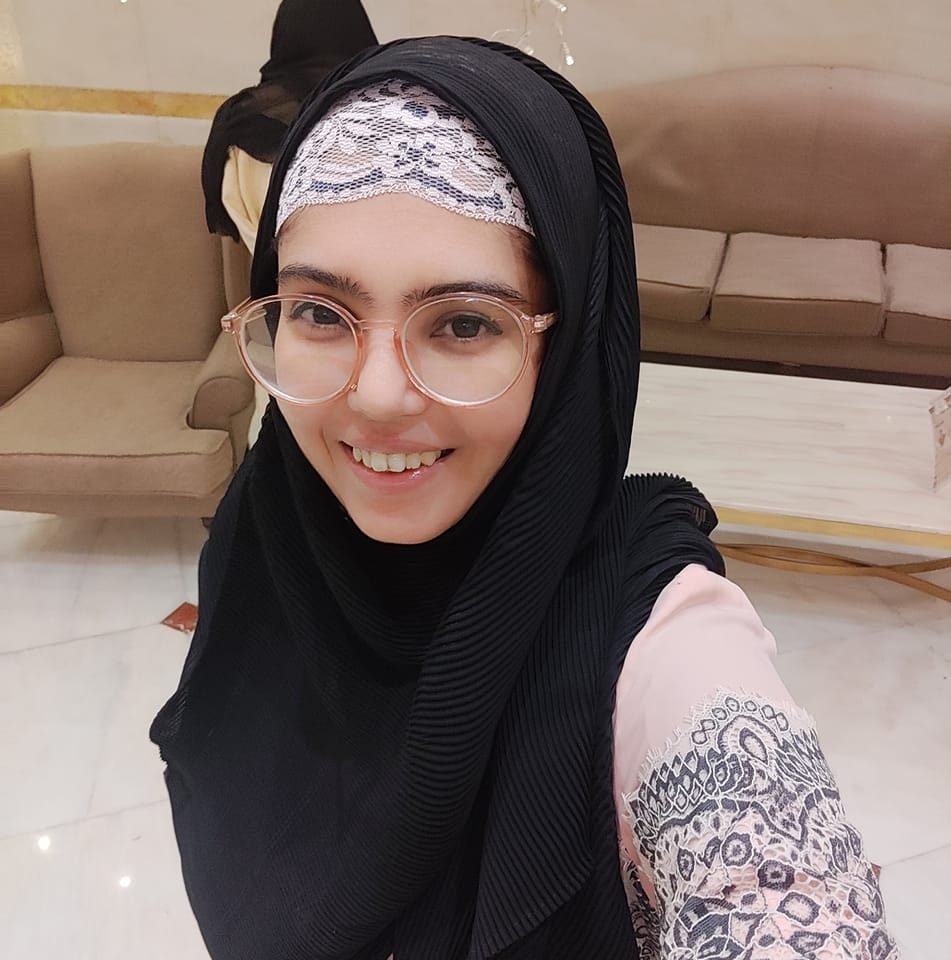
Afreen Hafsa is a fashion designer specializing in modest wear and abaya design. With over a decade of hands-on experience in fashion design training, fabric selection, and production coordination, she works closely with manufacturing teams to ensure quality, fit, and practicality for wholesale and bulk orders.
Very good i like it
wish you all the best